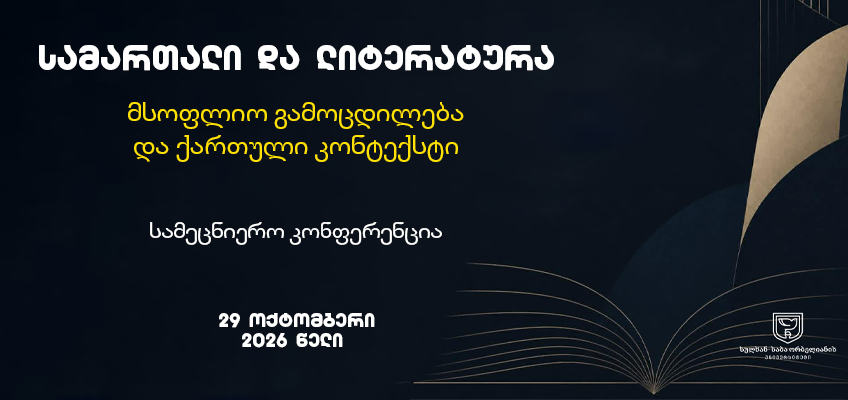
29Oct,2026
Law and Literature - Global Experience and the Georgian Context
Place:Sulkhan-Saba Orbeliani University
Date of placement:11/05/2026
Law is a fundamental pillar of human governance, statehood, social structure, and security. It regulates social relations, defines the scope of responsibility, and establishes a legal framework for justice. At the same time, the concepts of law and justice are multifaceted and often ambivalent: while law is viewed as the primary guarantor of human rights and freedoms, it is also frequently perceived as an instrument of social control and oppression.
This ambivalence is particularly acute in so-called fragile democracies states with a complex history of totalitarian or colonial rule. In these contexts, the discrepancy between formal legal norms and their practical enforcement remains a significant challenge, alongside issues of institutional accountability and the role of moral values in legal processes.
In this regard, literature provides a vital space for reflecting on these dilemmas. Literary texts, whether directly or indirectly, expose the hidden power mechanisms of law, illustrate various forms of social inequality, and depict the transformation of the concept of justice.
The Georgian experience and contemporary reality highlight these dilemmas with particular intensity—including the lack of public trust in the judicial system, contradictions in legal practice, and the crisis of ethics within the legal profession. This underscores the urgent need for critical analysis and academic discourse.
The conference "Law and Literature: Global Experience and the Georgian Context" aims to address this need. The Scientific Committee welcomes submissions that offer a broad analysis of legal issues and dilemmas as explored in world and Georgian literature.
Key Themes of the Conference (including, but not limited to):
-
Law and Power in Literary Narratives: How legal authority is formed and legitimized within various systems and how literature reflects this process.
-
Ethics, Morality, and Legal Responsibility: Conflicts between law and conscience; artistic reflections of civil disobedience and resistance.
-
The "Outsider" and the Limits of the Legal System: Issues of legitimate protest versus criminalization; the confrontation of individual morality with the official legal order.
-
Law in Totalitarian and Authoritarian Regimes: Mechanisms for legalizing state violence and narratives of systemic injustice in literary texts.
-
Collective and Individual Responsibility: The moral choice between obedience and resistance; the ethical foundations of legal liability.
-
Narratives of Trauma, Historical Memory, and Justice: Literature as a form of reflecting on social and legal experiences.
-
Marginalized Groups in Literature: Minorities, prostitution, social exclusion, and legal regulations.
Participation and Submission Guidelines
We invite researchers, PhDs, and doctoral students from the fields of Law, Social Sciences, and Humanities to participate.
Submission Requirements: Interested participants must submit the following in both Georgian and English:
-
Presentation Title
-
Abstract (150-200 words)
-
3-5 Keywords
-
Short Biography (100-200 words)
Email for submissions: conferences@sabauni.edu.ge
Important Dates:
-
Abstract Submission Deadline: September 15, 2026
-
Notification of Acceptance: September 25, 2026
-
Conference Date: October 29, 2026
-
Venue: Sulkhan-Saba Orbeliani University, Tbilisi, Georgia
Committees
Scientific Committee: Giorgi Meskhi (Sulkhan-Saba Orbeliani University); Kakhaber Loria (Ivane Javakhishvili Tbilisi State University); Levan Tsagareli (Ilia State University); Irine Darchia (Ivane Javakhishvili Tbilisi State University); Mzia Jamagidze (Sulkhan-Saba Orbeliani University); Davit Maisuradze (Ilia State University); Nino Vakhania (Sokhumi State University); Ana Gogilashvili (Sulkhan-Saba Orbeliani University); Eka Vardoshvili (Ivane Javakhishvili Tbilisi State University); Dimitri Gegenava (Sulkhan-Saba Orbeliani University).
Organizing Committee: Mzia Jamagidze; Dimitri Gegenava; Nino Deminashvili; Elene Sidamonidze.